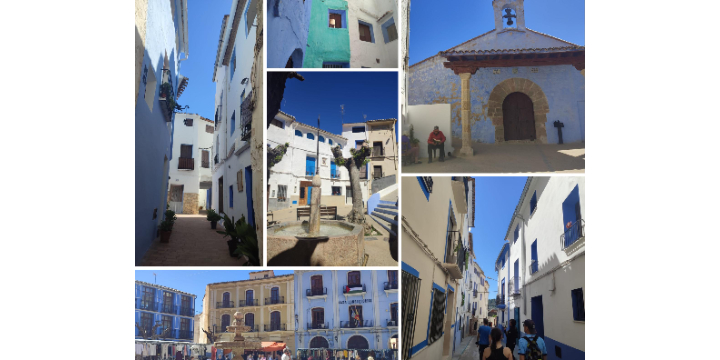
As part of the International University Campus on Mediterranean Biosphere Reserves, Lucía Fernández Lafuente developed her Bachelor's Final Degree Project during the 2025-2026 academic year under the supervision of Roser Maneja (UAB). Her research focused on safeguarding traditional ecological knowledge and intangible heritage in the Alto Túria Biosphere Reserve, contributing to current efforts to strengthen the resilience of Mediterranean Biosphere Reserves.
Developed within a collaborative research framework involving other students, the project benefited from a jointly designed survey and a shared learning process promoted by the Campus. In this interview, Lucía shares her main findings and reflects on the role of local communities, traditional knowledge and participatory approaches in supporting sustainable development and conservation across Mediterranean Biosphere Reserves.
1. Could you briefly introduce yourself and tell us about your educational background?
My name is Lucía Fernández Lafuente and I am from Castellón de la Plana, Spain. As I have always been passionate about nature, I decided to study the Double Degree in Environmental Sciences and Geology at the Autonomous University of Barcelona (UAB). Looking back, it was an excellent decision, as it gave me a much deeper understanding of nature and its management.
2. What inspired you to choose your research topic, and why do you think it is important for Mediterranean Biosphere Reserves?
I chose this topic because preserving traditional knowledge is essential for conserving our landscapes. When traditional practices are abandoned, ecosystems often deteriorate. I therefore considered it important to develop a practical tool such as an inventory that can support conservation efforts. In Mediterranean Biosphere Reserves, safeguarding intangible heritage and Traditional Ecological Knowledge (TEK) is crucial for maintaining resilience in the face of rural depopulation and climate change.
3. What were the main objectives of your study, and what are the most relevant findings or conclusions?
The objective was to create a practical tool for inventorying intangible heritage, using Alto Túria as a case study. My main conclusion is the contradiction between the high value institutions place on traditional knowledge and its actual decline in practice. For example, the traditional technique of whitewashing façades provided bioclimatic and insulating benefits, but it has been replaced by commercial plastic paints for aesthetic and tourism-related reasons, causing the loss of its genuine ecological function.
4. How did working with local stakeholders, communities, or institutions contribute to your research experience?
It was the most enriching part of the project. In Chelva and Tuéjar I was able to compare theory with local realities. Through interviews with older residents, I learned that although there are institutional initiatives to recover traditional architecture, the bureaucracy involved in accessing grants discourages an ageing population. This shows that policies must always be adapted to the real capacities of local communities.
5. In your opinion, how can your research contribute to the sustainable development and conservation of Mediterranean Biosphere Reserves?
The recent MedMAB Network Action Plan 2026-2030 calls for the urgent inventorying of this heritage. In response, I designed an inventory sheet based on UNESCO guidelines and the European MAES programme. This tool enables managers to identify real threats and take strategic action, helping Biosphere Reserves remain resilient.
6. What advice would you give to future students interested in carrying out research in a Mediterranean Biosphere Reserve?
I would encourage them to listen to local communities, as older generations hold highly valuable ecological knowledge. Integrating this social dimension is essential if environmental strategies are to be truly effective. I would also recommend making the most of networks such as MedMAB to exchange challenges and solutions, as they provide valuable international learning opportunities.
Lucía’s work, in the local language (Catalan), is available here.
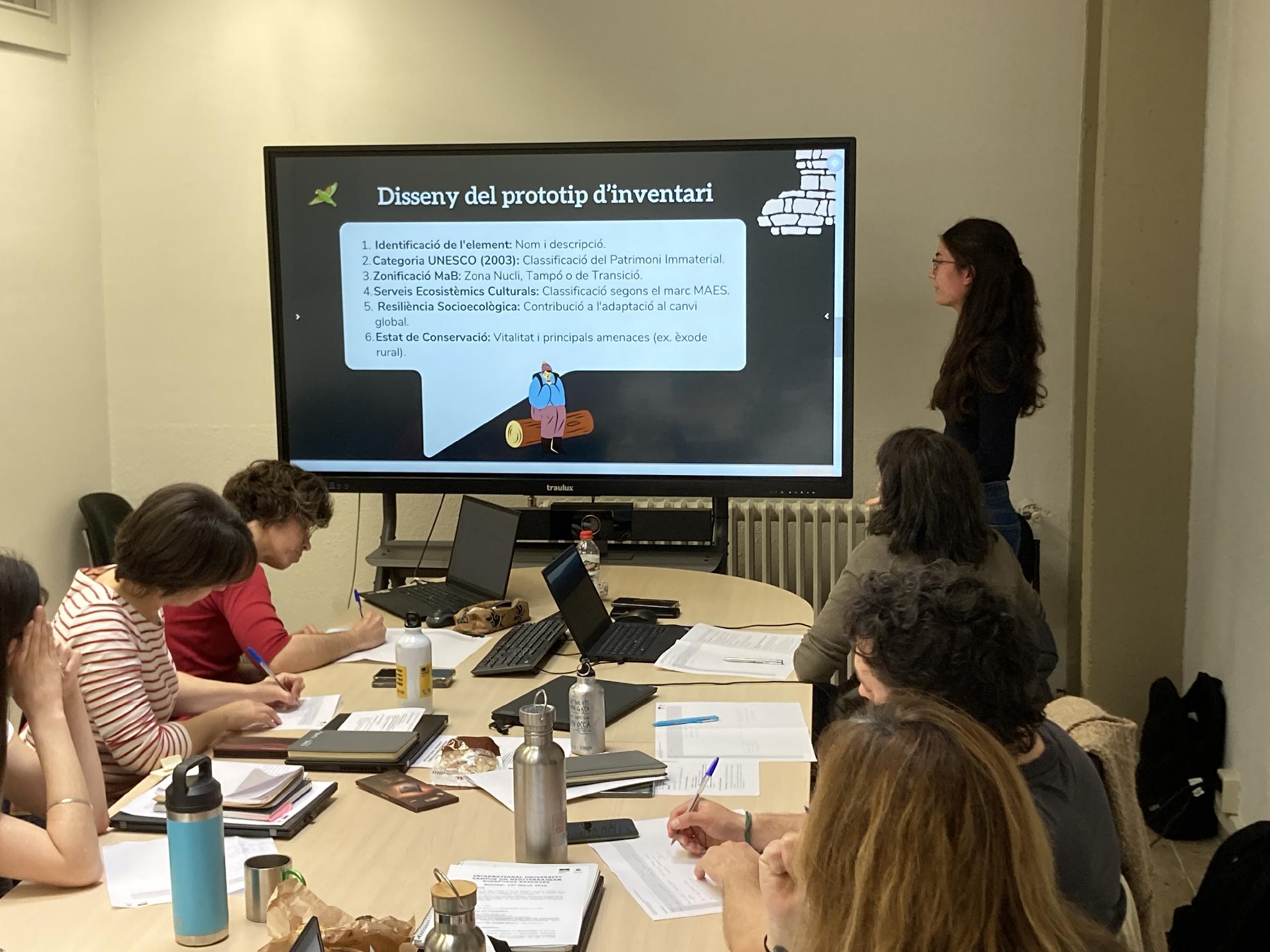 Lucía introducing her study in a seminar, with other students of the Campus and the UNESCOMED team.
Lúcia and the UNESCOMED team warmly thanks the Alto Túria Biosphere Reserve, its management team, and the local communities who took part in this research. The willingness of residents, local stakeholders, and community members to share their knowledge, memories, and experiences greatly enriched the study. Their hospitality, commitment to their territory, and generous participation during the fieldwork provided invaluable insights and made this research possible.
22 October 2026
As part of the International University Campus on Mediterranean Biosphere Reserves, Lucía Fernández Lafuente developed her Bachelor's Final Degree Project during the 2025-2026 academic year under the supervision of Roser Maneja (UAB). Her research focused on safeguarding traditional ecological knowledge and intangible heritage in the Alto Túria Biosphere Reserve, contributing to current efforts to strengthen the resilience of Mediterranean Biosphere Reserves.
8 October 2026
The International University Campus for Mediterranean Biosphere Reserves brings together students and researchers at Castellet Castle
30 September 2026
Italy’s Monte Peglia UNESCO MAB Biosphere Reserve joins the MedMAB network, bringing the network to 73 Biosphere Reserves.